

Leaving Your Job? A Step-By-Step Guide to Rolling Over Your 401(k) Without Triggering Taxes or Penalties
By Dan Gould | Three Streams Financial — Independent, Fee-Only Fiduciary Advisor
A 401(k) rollover to an IRA is one of the most common — and most commonly mishandled — moves in the entire workplace-to-retirement transition. Done right, it’s a simple, tax-free transfer. Done wrong, it can trigger mandatory withholding, a surprise tax bill, and even a 10% early withdrawal penalty. I see this play out constantly with retirees and near-retirees across the Kansas City metro, from Overland Park and Leawood on the Kansas side to Lee’s Summit and Kansas City on the Missouri side. The mistakes are almost always avoidable, and they almost always come down to one of a few technical details people simply aren’t told about.
Quick answer: To roll over a 401(k) to an IRA without triggering taxes or penalties, always request a direct (trustee-to-trustee) transfer — never a check made payable to you. A direct rollover avoids the mandatory 20% federal withholding and the 60-day redeposit deadline entirely. If you’re 55 or older and separating from your current employer, check whether you’ll want penalty-free access under the IRS Rule of 55 before rolling over, since that access disappears permanently once the funds move into an IRA.
Do you know the right way to move a 401(k) without the IRS taking an unnecessary cut?
This post will walk through:
- What actually happens to your 401(k) the day you leave a job
- Why a direct rollover beats a check made payable to you, almost every time
- How the 60-day rule and mandatory 20% withholding can quietly cost you thousands
- Why rolling over too early can cost you the Rule of 55 exception
- The step-by-step process for moving a 401(k) to an IRA cleanly
- What Kansas and Missouri retirees in particular should double-check before signing anything
Let’s get into it.
What Happens to Your 401(k) the Day You Leave Your Job
When you separate from an employer, you generally have four choices for an old 401(k): leave it where it is, roll it into your new employer’s plan, roll it into an IRA, or cash it out. Cashing out should almost never be on the table before 59½ — it triggers ordinary income tax on the full balance plus a 10% penalty. The right choice between the other three depends on fees, investment options, and one detail people overlook: whether you might need penalty-free access to that money before 59½.
Step 1: Confirm You Actually Need to Move the Money
Before you touch anything, ask whether a rollover is even the right move yet. If you’re 55 or older and separating from your current employer, the IRS Rule of 55 lets you withdraw from that specific employer’s 401(k) without the 10% penalty. That access disappears the moment you roll those funds into an IRA, since IRAs follow the standard 59½ rule with no separation-from-service exception. If you’re already building or catching up on your retirement income plan, it’s worth mapping out whether you’ll need early access before deciding to move a dime.
Step 2: Always Choose a Direct (Trustee-to-Trustee) Rollover
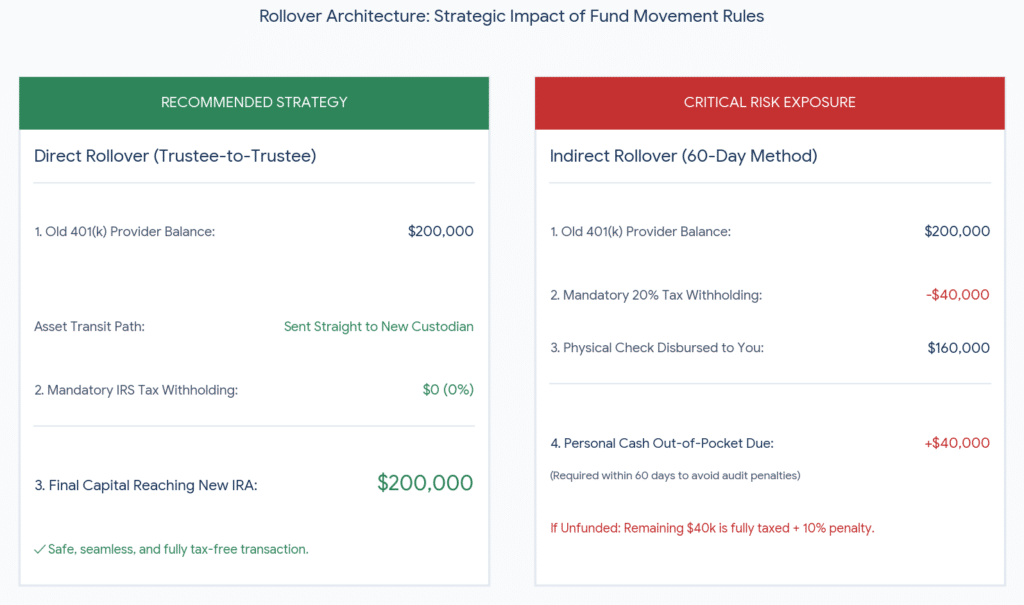
This is the single most important technical detail in this whole process. A direct rollover means your old plan sends the money straight to your new IRA custodian. You never touch it, and no taxes are withheld. An indirect rollover means the plan cuts a check payable to you, and by law it must withhold 20% for federal taxes first.
Here’s why that matters: say you have $200,000 in an old 401(k) and request an indirect rollover. Your old plan withholds $40,000 and sends you $160,000. To roll over the full $200,000 tax-free, you must deposit all $200,000 into your IRA within 60 days. That means finding the missing $40,000 from your own savings. If you only redeposit the $160,000 you actually received, the remaining $40,000 will be treated as a taxable distribution. If you’re under 59½, it also owes the 10% early withdrawal penalty. You do eventually get the withheld amount credited on your tax return, but only after filing — not in time to help you meet the deadline.
Step 3: Open the Receiving IRA Before You Call Your Old Plan
Have your new IRA account open and ready before you request the rollover. This lets you request a direct, trustee-to-trustee transfer from day one, rather than being forced into a check-in-hand indirect rollover because you had nowhere for the funds to land.
Step 4: If You Do Go Indirect, Watch the 60-Day Clock Like a Hawk
Sometimes an indirect rollover is unavoidable. If that’s your situation, mark the 60-calendar-day deadline immediately. Fund the full gross amount, including whatever was withheld, well before it expires. Also know that the IRS allows only one indirect IRA-to-IRA rollover in any rolling 12-month period, across all your IRAs combined. This limit does not apply to direct rollovers or trustee-to-trustee transfers, which is one more reason direct is almost always the better route.
The Rule of 55 Trap Almost Nobody Mentions
This is the mistake I see most in my Kansas and Missouri practice: retirees roll an old 401(k) into an IRA out of habit. They don’t first check whether they’ll want penalty-free withdrawals between 55 and 59½. Once that money moves into an IRA, the Rule of 55 access is gone permanently for those dollars. If early access is part of your plan, it may be worth leaving that specific 401(k) in place a while longer before rolling it over.
Other Penalty Exceptions Worth Knowing
Beyond the Rule of 55, the IRS allows other exceptions to the 10% early withdrawal penalty. These include disability, certain medical expenses, qualified domestic relations orders, and 72(t) Substantially Equal Periodic Payments. Income tax still applies in nearly every case; only the 10% penalty is waived. These are narrow, technical exceptions, so confirm eligibility with a qualified professional before relying on one.
Step 5: Confirm the Paperwork Lands Correctly
A direct rollover should be reported on Form 1099-R with distribution code G, showing it as a non-taxable rollover. Your IRA custodian will also issue a Form 5498 confirming the deposit. Check both once tax season arrives — a mis-coded 1099-R is a common source of unnecessary IRS notices.
Putting It All Together: A Clean Rollover Sequence
To roll over a 401(k) to an IRA, first confirm if you need Rule of 55 access. Open the IRA, request a direct trustee-to-trustee transfer, and verify the 1099-R and 5498 forms. Skipping a step risks unnecessary withholding, a missed deadline, or the loss of penalty-free access. Next, decide what investments fit your new IRA. The rollover is only the start of your retirement income plan — see how the accounts you roll over fit into a broader tax-efficient withdrawal strategy once you’re actually drawing income from them.
Frequently Asked Questions
What’s the difference between a direct and an indirect 401(k) rollover?
A direct rollover sends funds straight from your old 401(k) to your new IRA custodian — you never touch the money, and nothing is withheld. An indirect rollover cuts a check payable to you, and the plan is required to withhold 20% for federal taxes before sending it, even though you’re still responsible for redepositing the full original amount within 60 days.
How long do I have to complete a 401(k) rollover?
For an indirect rollover, you have 60 calendar days from the date you receive the funds to redeposit the full amount, including any withheld taxes, into an IRA or new employer plan. A direct, trustee-to-trustee transfer has no such deadline since the funds never pass through your hands.
Will I lose access to my money if I roll over my 401(k) at age 55?
Yes, potentially. The IRS Rule of 55 allows penalty-free withdrawals from your current employer’s 401(k) if you separate from service at age 55 or older, but this exception applies only to 401(k) plans, not IRAs. Rolling those funds into an IRA permanently forfeits that penalty-free access for those specific dollars.
How many 401(k)-to-IRA rollovers can I do in a year?
Direct, trustee-to-trustee rollovers have no limit and can be done as often as needed. However, the IRS allows only one indirect IRA-to-IRA rollover in any rolling 12-month period, across all of your IRAs combined — another reason a direct rollover is almost always the safer route.
Key Takeaways
- A direct (trustee-to-trustee) rollover avoids both mandatory 20% withholding and the 60-day deadline entirely — request this whenever your old plan allows it
- An indirect rollover requires you to redeposit the full gross amount, including the withheld 20%, within 60 days or face taxes and a possible 10% penalty
- Rolling a 401(k) into an IRA permanently forfeits Rule of 55 penalty-free access for those funds — confirm you won’t need it first
- Open your new IRA before requesting any transfer, so you’re never forced into a check-in-hand rollover
- Confirm your 1099-R shows distribution code G and that a Form 5498 arrives from your new custodian
Whether you’re retiring in Overland Park, Kansas City, or anywhere else across Kansas and Missouri, the rollover mechanics are the same. The right sequence still depends on your full retirement picture, including how much income you’ll actually need and how Medicare timing fits alongside it.
Fee-Only Advice. Proven Process. Transparent Planning.
Remember, there’s no one-size-fits-all approach to a 401(k) rollover. Conduct thorough research, consider your personal circumstances, and consult a fee-only fiduciary advisor before moving retirement funds.
P.S. Navigating a workplace transition to retirement? I’ve created a free Personalized Retirement Map that addresses all four critical areas: Income, Investments, Planning, and Legacy. No pitch, just clarity.
Get Your Free Personalized Retirement Map
Related Reading
Once your rollover is complete, see how to sequence withdrawals tax-efficiently in How to Pay Less Tax in Retirement, or check How Much Do I Need to Retire in Kansas? to see how this fits your broader number. Learn more about our investment management approach, or get in touch before moving retirement funds.

Hello, I’m Dan Gould, an independent fee-only advisor based in Overland Park, KS. I offer comprehensive financial services to individuals, families, professionals, and small business owners nationwide. With over 25 years of experience in institutional financial markets, I deliver proven portfolio management and retirement income strategies.