

How to Pay Less Tax in Retirement: The Optimal Order of Account Distributions
By Dan Gould | Three Streams Financial — Independent, Fee-Only Fiduciary Advisor
Here’s a mistake that costs retirees real money. Withdrawing from the wrong account, in the wrong order, at the wrong time. It sounds small. It isn’t.
The wrong withdrawal order can push you into a higher tax bracket. It can trigger steep Medicare premium surcharges (IRMAA). It can expose more of your Social Security to taxation than necessary. All from decisions that felt harmless in the moment. If you live in Kansas and work in Missouri (or the reverse), this gets an extra layer of complexity — see The Cross-State Retirement Map for how residency and income sourcing affect which state taxes each withdrawal.
Quick answer: The optimal retirement withdrawal order isn’t a fixed sequence you follow forever — it’s an annual, bracket-based decision. Instead of draining taxable accounts first, then tax-deferred accounts, then Roth last (the common default), a fiduciary approach withdraws proportionally from taxable, tax-deferred, and Roth accounts each year to deliberately fill your lower tax brackets. Done well, this reduces lifetime taxes, IRMAA surcharges, and the size of future Required Minimum Distributions (RMDs), which currently begin at age 73.
This post will cover:
- Why withdrawal order matters more than most people realize
- The standard sequence most brokers default to, and why it falls short
- A step-by-step framework for the optimal withdrawal order
- The two biggest tax traps in retirement, and how to avoid them
Why Withdrawal Order Is the Decision Nobody Talks About
Most retirement content focuses on saving. Max out your 401(k). Contribute to a Roth. Build the number. That advice is useful, but it stops right where the real complexity begins.
Once you retire, the question flips. Now you’re deciding which account to pull from, this year, and the next, and the year after that. Every account is taxed differently. Get the order wrong, and you can pay meaningfully more tax than necessary, year after year, for the rest of your retirement.
This isn’t a one-time decision either. It compounds. A poorly sequenced withdrawal in your first retirement year can echo for decades, through higher RMDs later, through Medicare surcharges, through Social Security taxation. Small mistakes early become expensive mistakes late.
The Traditional Sequence vs. The Fiduciary Reality
Most brokers, and most generic retirement calculators, default to the same basic order. Here’s how that standard approach compares to what real, comprehensive planning actually requires.
The standard method isn’t wrong, exactly. It’s just incomplete. It treats each account type as a separate bucket, drained one at a time. Real tax optimization treats all your accounts as one system, coordinated together, every single year.
This is also where dividend growth investing plays a role. A portfolio built around rising dividend income can supply some of your annual cash flow without forcing a sale from any single account. That gives you more flexibility to fill tax brackets deliberately, instead of being forced into a withdrawal by cash flow needs alone.
The Optimal Withdrawal Order Framework, Step by Step
There’s no universal withdrawal order that works for everyone, but the underlying process is consistent. Here’s the framework we walk through with clients every year:
- Calculate your current-year tax bracket first — before taking any discretionary withdrawals — using guaranteed income like Social Security and pensions as the baseline.
- Identify how much “room” remains in your current bracket before you’d cross into the next one.
- Withdraw from taxable accounts first to fill that room, since qualified dividends and long-term capital gains are often taxed at 0% or 15% for many retirees.
- Use tax-deferred accounts (Traditional IRA, 401(k)) to fill any remaining room in your target bracket deliberately — not by default.
- Consider a Roth conversion for any additional room you’re comfortable filling, especially during the years between retirement and age 73.
- Preserve Roth IRA withdrawals for last, or for large, unplanned expenses, since qualified Roth withdrawals are tax-free and don’t affect your bracket.
- Repeat this analysis every year — your bracket, tax law, and account balances all change, so last year’s plan isn’t automatically this year’s plan.

Strategic Tax Traps to Evade
Two specific traps catch retirees more than any others. Both are avoidable, but only with planning that starts years in advance.
The RMD Tax Cliff
A lifetime of diligent saving in tax-deferred accounts feels responsible. It is. But it sets up a future problem. Required Minimum Distributions currently begin at age 73. They force withdrawals whether you need the income or not. For disciplined savers, RMDs can be large enough to push you into a meaningfully higher tax bracket than you ever experienced while working. Combined with Social Security, this can create the single largest tax burden of your entire retirement, arriving all at once in your seventies.
Proactive Roth Conversions
Here’s the good news. There’s a specific window built for solving this exact problem. It falls between when you stop working and when RMDs begin. During these years, your taxable income is often lower than at any other point in retirement. That makes it an ideal window to convert traditional IRA funds into a Roth IRA, paying tax now at a lower rate, instead of later at a potentially higher one. Done well, this single strategy can meaningfully shrink your future RMDs, and the tax bracket jump that comes with them.
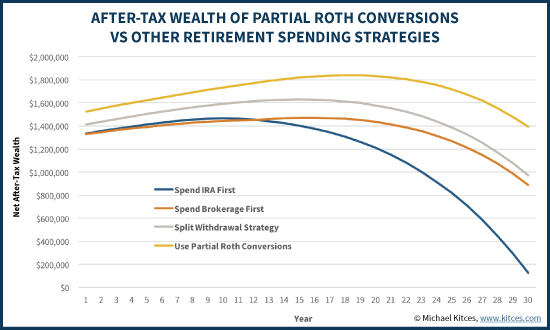
Neither of these traps announces itself in advance. They show up as a surprise tax bill, years after the decisions that caused them. That’s exactly why this kind of planning benefits from a fee-only fiduciary, someone with a direct, ongoing incentive to map this out years ahead, not react to it after the fact.
LEARN MORE AT OUR FREE DIVIDEND GROWTH WORKSHOP COMING UP SOON – CLICK HERE!
Frequently Asked Questions
What is the standard retirement withdrawal sequence?
The standard method most brokers use is to withdraw from taxable brokerage accounts first, then tax-deferred accounts like Traditional IRAs and 401(k)s, and Roth accounts last. It’s simple, but it ignores your actual tax bracket each year, which can lead to larger tax bills later in retirement.
How do Required Minimum Distributions affect my retirement taxes?
RMDs currently begin at age 73 and force withdrawals from tax-deferred accounts whether you need the income or not. For diligent savers, this can push you into a meaningfully higher tax bracket, especially when combined with Social Security income, creating a larger tax burden than expected.
When is the best time to do a Roth conversion?
The ideal window is typically between when you stop working and when RMDs begin, since your taxable income is often lower during these years. Converting traditional IRA funds to a Roth IRA during this window means paying tax now at a lower rate instead of a potentially higher rate later.
What order should I withdraw from my retirement accounts?
Rather than a fixed order, withdraw proportionally across taxable, tax-deferred, and Roth accounts each year to deliberately fill your current tax bracket — drawing from taxable accounts first to use low capital-gains rates, then tax-deferred accounts, then considering a Roth conversion, and preserving Roth withdrawals for last.
Key Takeaways
- Withdrawal order matters as much as how much you’ve saved, since the wrong sequence can trigger a higher tax bracket, IRMAA surcharges, and added Social Security taxation.
- The standard broker default, taxable accounts first, then tax-deferred, then Roth, is simple but often incomplete for true tax optimization.
- Real tax optimization fills your lower tax brackets deliberately every year, using proportional withdrawals across account types together.
- The RMD tax cliff and the Roth conversion window are the two biggest levers in this entire strategy, and both require planning years in advance.
Fee-Only Advice. Proven Process. Transparent Planning
Remember, there’s no one-size-fits-all approach to retirement withdrawal planning. Conduct thorough research, consider your personal circumstances, and consult a fee-only fiduciary advisor before making changes to your withdrawal strategy.
P.S. Wondering whether your own withdrawal order is quietly costing you? Don’t leave the tax efficiency of your hard-earned savings to chance. Click here to request your Personalized Retirement Income Blueprint from our independent, fee-only team. We will help you build a clear, bracket-optimized withdrawal sequence engineered to protect your wealth throughout retirement.
Related Reading
For more on this topic, see The Decumulation Roadmap and Retirement Tax Strategies for Kansas City Families. If part of your household lives in Kansas and works in Missouri (or the reverse), also see The Cross-State Retirement Map. Learn more about why fee-only fiduciary advice matters, or reach out to map out your own withdrawal order.
Three Streams Financial, LLC is an independent financial firm. Investment advisory services are offered through CreativeOne Wealth, LLC, a registered investment adviser. CreativeOne Wealth and Three Streams Financial are unaffiliated entities. This graphic is for informational and educational purposes only and should not be construed as personal tax, legal, or investment advice. Consult a qualified CPA or fiduciary advisor regarding your specific multi-state tax footprint.

Hello, I’m Dan Gould, an independent fee-only advisor based in Overland Park, KS. I offer comprehensive financial services to individuals, families, professionals, and small business owners nationwide. With over 25 years of experience in institutional financial markets, I deliver proven portfolio management and retirement income strategies.