

Dividend Growth Investing in 2026: Build Lasting Wealth With Compounding Income

Data Source: FastGraphs.com
(Updated for 2026)
By Dan Gould | Three Streams Financial — Independent, Fee-Only Fiduciary Advisor
Dividend growth investing (DGI) remains one of the most powerful ways to create exponential compounding and lifetime income. Back in February 2024, we explored how DGI creates exponential compounding and lifetime income in “The Power of Dividend Growth Investing”. The message still holds true — and heading into 2026, with valuations stretched and rate-cut timelines pushed further out, it’s more relevant than ever.
Quick answer: Dividend growth investing means holding companies with a long, consistent record of raising their dividend, then reinvesting the payouts so they compound. Starting with $500,000 at a 3.5% yield and 7% annual dividend growth, with dividends fully reinvested, a portfolio could generate over $100,000 a year in income within 20 years — without ever selling a share. It has also historically shown 20–30% lower volatility than the broader market, making it one of the more resilient strategies for a high-valuation environment like 2026.
Why? In today’s high-valuation, higher-rate environment, more investors are looking for strategies that balance resilience, income, and long-term growth. Dividend Growth Investing checks all those boxes — and more.
This post will discuss:
- Why dividend growth investing still works in 2026
- How compounding dividend income leads to financial freedom
- What makes a strong dividend growth portfolio today
Would you rather depend on market timing or build a portfolio that pays you for decades?
What Is Dividend Growth Investing—and Why It Still Works in 2026
Dividend growth investing means focusing on companies with a consistent record of paying and increasing dividends. These are typically strong, cash-rich businesses with pricing power and disciplined capital allocation.
Unlike speculative growth stocks or low-yield bonds, dividend growers provide:
- A rising income stream
- Lower portfolio volatility
- Built-in inflation protection
Heading into 2026, the Shiller CAPE ratio is trading near 41 — closing in on the all-time record set at the dot-com peak — while the S&P 500’s dividend yield has fallen to around 1.1%. With valuations this stretched and bond yields delivering mixed results, investors need a way to stay invested without betting everything on market performance. That’s where DGI shines.
Why Compounding Income Is the Key to Financial Freedom
The magic of DGI isn’t just receiving dividends—it’s reinvesting them and letting them compound.
Consider this scenario:
- An initial investment of $500,000 in a portfolio with a 3.5% yield
- Each year, with an annual dividend growth of 7%
- You reinvest all dividends
In 20 years, your portfolio could produce over $100,000 per year in income, without ever selling a single share. These are hypothetical assumptions used for illustration, not a guarantee of future returns. Curious how this plays out with real dollar figures and a real client scenario? See our case study on building a $150,000-a-year retirement income plan by age 62.
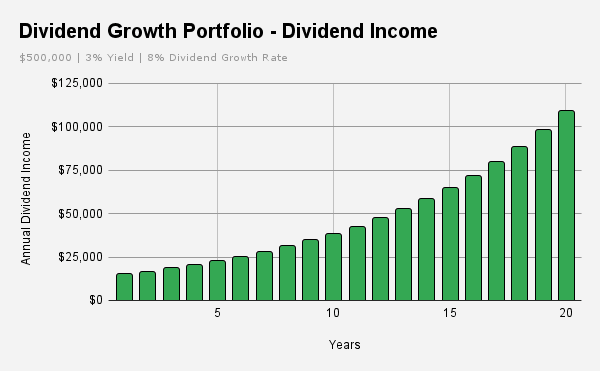
That’s the power of exponential compounding. You’re not just growing a nest egg—you’re building a self-funding income engine. It’s also the same mechanism behind raising your safe withdrawal rate in retirement: rising income means less pressure to sell shares in a down market.
Here’s how the compounding cycle works:
- Dividends generate income
- Reinvested income buys more shares
- More shares create larger future dividends
- Cycle repeats—automatically
It’s wealth creation on autopilot!
What Makes a Strong Dividend Growth Portfolio in 2026
Not all dividend stocks are created equal. In today’s environment, you want companies with:
- Low payout ratios (room to grow dividends)
- Strong free cash flow
- Long track records of consistent dividend increases
Some examples of current dividend growth leaders heading into 2026 include:
- PepsiCo (PEP) – Now a Dividend King with 54 consecutive years of dividend increases and a yield near 4%, well above its 5-year average (“Why PepsiCo Was Added to Client Portfolios”)
- Microsoft (MSFT) – Balances dividend growth with capital appreciation
- AbbVie (ABBV) – A high-yield grower benefiting from new drug pipelines
Your dividend growth portfolio should:
- Span sectors (consumer staples, healthcare, utilities)
- Focus on quality, not just yield
- Be built with a long-term mindset
This is exactly how we build these portfolios for clients — see our investment management approach for more on our process.
For a deeper look at where to find quality names today, see Why Now Is a Good Time to Look at Dividend Aristocrats.
What the Trends Say: Dividend Growth Beats in Uncertain Times
With inflation pressures lingering and interest rates still elevated, investors are shifting focus from speculation to cash flow generation.
Recent data shows:
- Dividend growers outperformed non-payers in 90% of rolling 10-year periods since 1980
- Volatility in dividend growth portfolios is 20–30% lower than in broad equity indexes, consistent with the pattern Ned Davis Research has found between dividend growers and non-payers over multiple market cycles
- Companies that grow their dividends tend to also outperform in earnings growth and stock price performance
This resilience isn’t just theoretical — see how the Dividend Aristocrats actually held up during the 2008 financial crisis compared to the broader S&P 500.
Frequently Asked Questions
How much can dividend growth investing actually produce over 20 years?
Under hypothetical assumptions of a 3.5% starting yield and 7% annual dividend growth, a $500,000 portfolio with dividends fully reinvested could generate over $100,000 a year in income within 20 years, without ever selling a share of principal. These figures are for illustration only and are not a guarantee of future results.
Is dividend growth investing a good strategy in 2026?
Yes, particularly given current conditions. With the Shiller CAPE ratio trading near 41 and the S&P 500’s dividend yield near historic lows around 1.1%, dividend growth investing offers a way to stay invested in quality businesses while generating a rising, more resilient income stream than relying purely on price appreciation.
What companies are considered strong dividend growth stocks?
Strong dividend growth stocks typically have low payout ratios, strong free cash flow, and a long track record of consistent dividend increases. Examples include PepsiCo, a Dividend King with 54 consecutive years of increases, as well as other established companies across consumer staples, healthcare, and utilities.
Does dividend growth investing reduce portfolio risk?
Historically, yes. Dividend growth portfolios have shown roughly 20-30% lower volatility than broad equity indexes, and dividend growers have outperformed non-dividend-payers in about 90% of rolling 10-year periods since 1980, though past performance does not guarantee future results.
In Conclusion
In 2026, the path to financial independence still involves compounding, consistency, and discipline—that’s what dividend growth investing delivers.
Whether just starting or managing a multi-million-dollar portfolio, focusing on high-quality dividend growers can help you sleep better and retire sooner. If you feel like you’re behind on savings, a late start doesn’t mean you’re out of options — see Still Feel Behind in Retirement Savings? Why 2026 Is the Year to Take Action. Three Streams Financial is an independent, fee-only investment advisor that helps working families and professionals retire with confidence. If you’re looking for tailored insights and a clear strategy, contact us.
Key Takeaways:
- Dividend Growth Investing continues to deliver in 2026—especially with the Shiller CAPE ratio near 41 and the S&P 500’s dividend yield near historic lows.
- Reinvesting dividends creates exponential compounding and a growing income stream.
- A well-constructed DGI portfolio can lead to six-figure passive income over time.
- You don’t have to be perfect. You just need a plan that works.
Fee-Only Advice. Proven Process. Transparent Planning.
Concerned about employer-stock concentration in Wichita? See how I approach that risk.
Remember, there’s no one-size-fits-all approach to investing. Do research carefully, consider personal circumstances, and consult a fee-only financial advisor before making investment decisions.
P.S. Want to see what a dividend growth core could look like in your own portfolio? I’ve created a free Personalized Retirement Map that addresses all four critical areas: Income, Investments, Planning, and Legacy. No pitch, just clarity. → Get Your Free Personalized Retirement Map
Related Reading
See the underlying compounding mechanics in The Power of Dividend Growth Investing, and read about the tax side of this strategy in The Magic of Dividend Growth Investing: How to Outpace Inflation in 2026. Learn more about our investment management approach, or get in touch to talk through your own plan.

Hello, I’m Dan Gould, an independent fee-only advisor based in Overland Park, KS. I offer comprehensive financial services to individuals, families, professionals, and small business owners nationwide. With over 25 years of experience in institutional financial markets, I deliver proven portfolio management and retirement income strategies.