
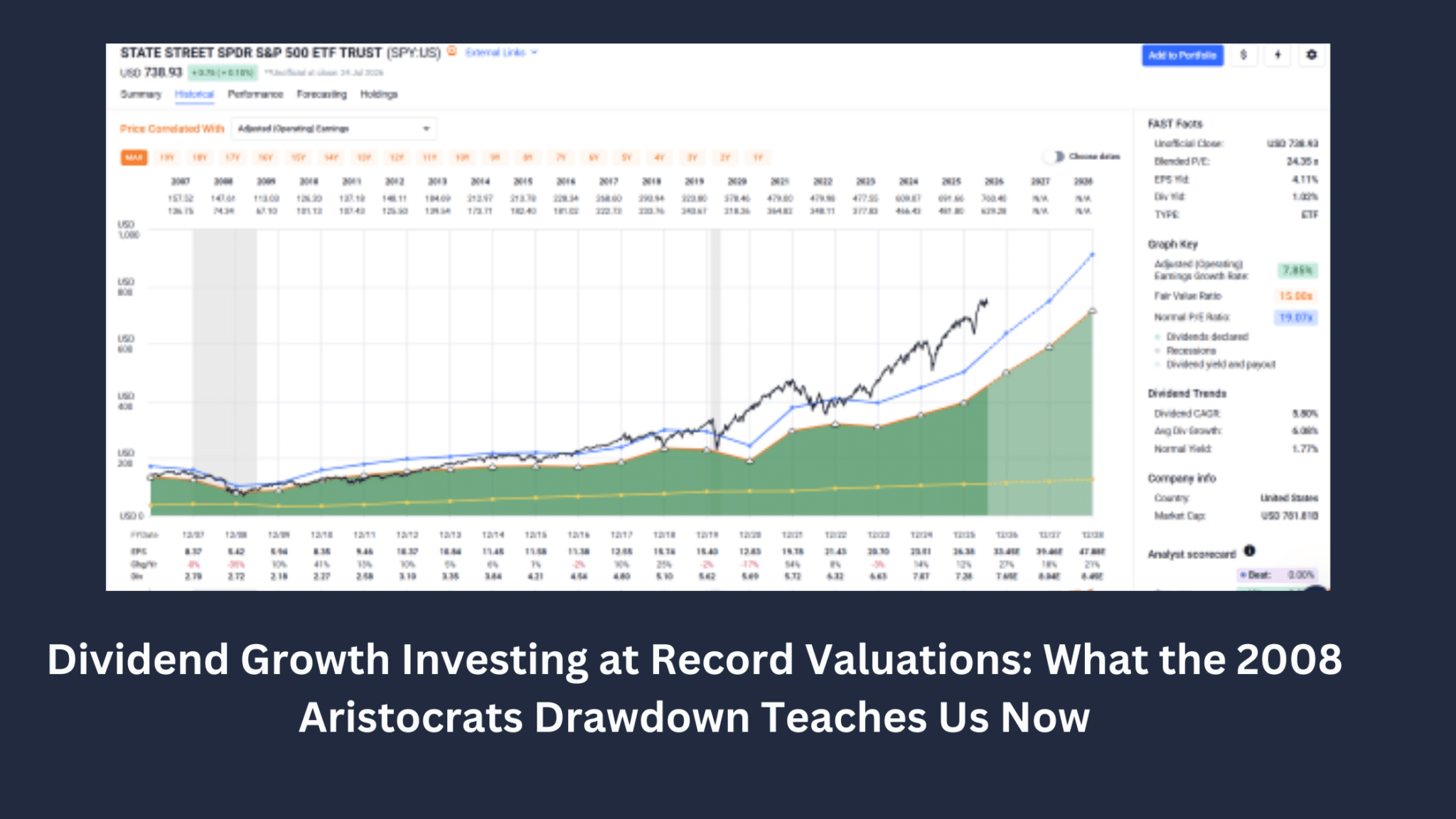
Dividend Aristocrats in the 2008 Crash: A Case Study for Today’s Investors
By Dan Gould | Three Streams Financial — Independent, Fee-Only Fiduciary Advisor
When a client asks me “what actually happens to my dividend growth stocks if the market takes a real hit,” I point them to the last time we got a genuine answer: the 2008 financial crisis. This post is a case study of exactly that — how the S&P 500 Dividend Aristocrats performed through that drawdown, which names held up best, and which ones lost their dividend streak entirely.
It’s a timely question because today’s market valuations are historically rich — for the full picture on just how stretched the Shiller CAPE ratio is right now and what it’s historically meant for forward returns, see our detailed breakdown: Shiller CAPE Ratio in 2026: What the 40+ Reading Means for Your Retirement. This post focuses specifically on the 2008 track record itself — not because a repeat is guaranteed, but because it’s the closest real-world stress test we have for how quality dividend growers behave when a richly priced market resets.
This post covers:
- A close look at the S&P 500 Dividend Aristocrats performance during the 2008 financial crisis drawdown
- The honest limits of that protection, including which Aristocrats got removed from the index for cutting their dividends
- Why interest rate cuts may not arrive in time — or in size — to rescue expensive stocks today
- What this 2008 case study means for how you position a portfolio today
2008 vs. Today: The Numbers Side by Side
Before diving into the full analysis, here’s the quick comparison I keep coming back to with clients:
| Metric | 2007–2008 (Pre-Crisis) | Today (2026) |
|---|---|---|
| Shiller CAPE ratio | ~27 (elevated, not extreme) | ~41 (near the dot-com record of 44.2) |
| S&P 500 dividend yield | ~1.9% | ~1.1% |
| S&P 500 calendar-year decline (2008) | ~37–38% | Unknown — historical reference only |
| Dividend Aristocrats decline (2008) | ~22% | Unknown — historical reference only |
| Expected Fed rate-cut timing | Cutting aggressively by late 2008 | Not expected before 2027, per several forecasters |
Today’s valuations are even richer than they were heading into 2008 — which is exactly why the Aristocrats’ 2008 track record, detailed below, is worth studying now. (Again, for the full valuation picture, see our Shiller CAPE ratio breakdown.)
Why Rate Cuts May Not Come to the Rescue
A common argument for staying fully invested despite rich valuations is that the Fed will eventually cut rates, lowering the discount rate applied to future cash flows and supporting even expensive stock prices. That argument looks shakier than it did a year ago. Inflation has stayed above the Fed’s 2% target, and forecasters have pushed back their timelines for the next rate cut — some now pointing to mid-to-late 2027 rather than this year. A few firms have gone further, suggesting cuts are “essentially off the table” for 2026, given persistent inflation pressure tied to tariffs, energy costs, and AI-infrastructure-related demand.
Lower rates, which have propped up markets for years, may not arrive as soon as investors hope. If earnings growth lags and rates stay high, valuations must adjust differently. That’s not a prediction of a crash. It’s a reminder that “priced for perfection” markets need actual perfection, and a backup plan is worth having.
S&P 500 Dividend Aristocrats Performance During the 2008 Financial Crisis Drawdown
This is where the historical record is genuinely useful. The last time U.S. equities went through a real valuation reset — the 2008 financial crisis — the S&P 500 Dividend Aristocrats Index (companies with at least 25 consecutive years of dividend increases) held up meaningfully better than the broader market:
- Calendar year 2008: The Dividend Aristocrats Index declined roughly 22%, compared to a decline of about 37–38% for the S&P 500 — a gap of roughly 15 percentage points in a single year.
- Peak-to-trough drawdown (October 2007–March 2009): The broader S&P 500 fell as much as 55% from its 2007 high to its 2009 low. The Aristocrats fell less than the S&P 500 during the crisis and have had smaller drawdowns long-term (-44% vs. -51%).
- Individual standouts: Some Aristocrats barely flinched. McDonald’s had the smallest peak-to-trough decline among the group, at roughly -22%, and was one of the few names to post positive returns in 2007, 2008, and 2009. Walmart’s maximum drawdown was about -26%.
Why did the group hold up better? Not magic — a quality screen. To qualify, a company must raise its dividend every year for at least 25 years—through recessions, oil shocks, and rate cycles. This rule weeds out weaker firms, helping explain why the group loses less in down years.
The Honest Caveat: Not Every Aristocrat Held Up
It’s important not to oversell this. Of about 60 Dividend Aristocrats in 2007, 17 were dropped for cutting dividends—mostly in 2008–2009 and mainly in the financial sector. Being a “dividend aristocrat” going into a crisis is not a guarantee of coming out the other side with the streak intact. The protection the index offers as a whole comes from the quality bar applied every year, not from any single company’s history.
What This Means for Dividend Growth Investors Today
I’m not predicting a repeat of 2008 — every cycle is different, and the causes of the next drawdown (if one comes) won’t look like a housing-and-banking crisis. But the 2008 experience is a useful data point precisely because it was the last time a genuinely overpriced, over-levered market had to reset. The Aristocrats didn’t avoid the pain. They cushioned it — and companies with the discipline to keep raising dividends through a crisis tended to be the ones with the balance sheets and cash flows to earn that resilience.
Focus On Dividend Growth Investing!
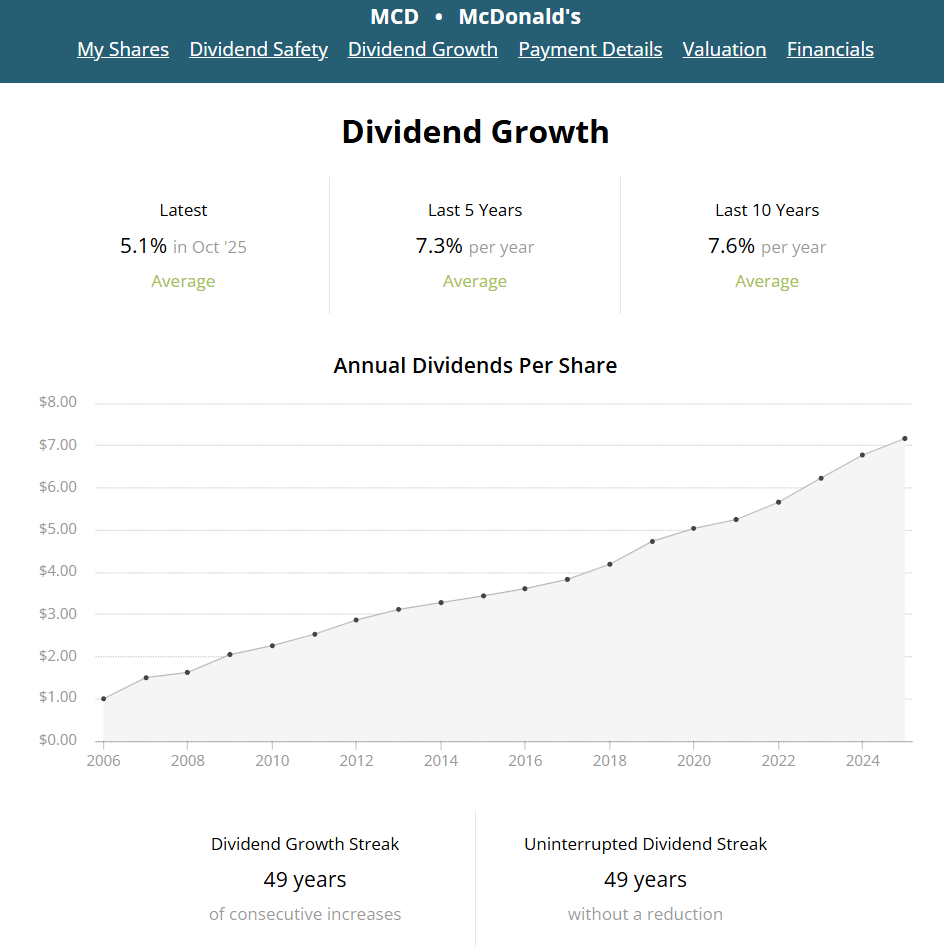
McDonald’s stock has shown steady dividend growth for years. This demonstrates the power of compounding for investors. As McDonald’s raises its dividend, your income from holding shares grows each year. Reinvesting these dividends helps your portfolio benefit from compounding returns. Over time, this can lead to significant income growth. Building a portfolio of dividend growth stocks, like McDonald’s, is a strong strategy. It steadily increases wealth through the compounding effect of rising dividends.
LEARN MORE AT OUR FREE DIVIDEND GROWTH WORKSHOP COMING UP SOON – CLICK HERE!
Given today’s valuation backdrop and a Fed that may not be cutting rates on the timeline the market wants, a few practical takeaways:
- Don’t confuse “expensive” with “about to crash.” Valuations can stay stretched for years. This is a case for positioning, not for timing an exit.
- Quality matters more than yield. The lesson from 2008 isn’t “buy anything called a Dividend Aristocrat” — it’s that balance-sheet strength and a long record of raising payouts through prior downturns are the traits worth screening for now, while conditions are calm.
- Diversify across sectors within dividend growers. The financial-sector cuts in 2008–09 are a reminder that even quality screens have blind spots in a specific sector during a specific type of crisis.
- Keep a real bond and cash allocation. Dividend growth reduces — it doesn’t eliminate — the need for a sensible mix that keeps you from being a forced seller if valuations do reset.
Key Takeaways
- During the 2008 financial crisis, the S&P 500 Dividend Aristocrats Index fell about 22% for the year versus roughly 37–38% for the S&P 500, and its peak-to-trough drawdown was meaningfully smaller than the broader market’s ~55% decline.
- Protection wasn’t universal—17 Aristocrats, mostly financials, were dropped for cutting dividends, showing quality and diversification matter more than the label.
- Today’s Shiller CAPE ratio has been trading above 40 — richer than the ~27 level heading into 2008 — which is exactly why this 2008 case study is worth revisiting now.
- Multiple major forecasters now expect the Fed’s next rate cut no earlier than 2027, weakening the “rate cuts will rescue valuations” argument many investors are leaning on.
Learn more about dividend growth investing:
- https://threestreamsfinancial.com/why-now-is-a-good-time-to-look-at-dividend-aristocrats/
- https://threestreamsfinancial.com/how-growing-dividends-can-raise-your-safe-withdrawal-rate-in-retirement/
Fee-Only Advice. Proven Process. Transparent Planning.
Remember, there’s no one-size-fits-all approach to investing. Conduct thorough research, consider your personal circumstances, and consult a fee-only financial advisor before making any investment decisions. Past performance, including the 2008 Dividend Aristocrats data referenced above, is not indicative of future results.
P.S. Want to see how your own portfolio is positioned for today’s valuation environment? I’ve created a free Personalized Retirement Map that addresses all four critical areas: Income, Investments, Planning, and Legacy. No pitch, just clarity. → Get Your Free Personalized Retirement Map
Worried about investing at today’s valuations while trying to catch up? We cover exactly that tension in: Still Feel Behind in Retirement Savings? Why 2025 Is the Year to Take Action.
Related Reading
For more on why we favor these companies today, see Why Now Is a Good Time to Look at Dividend Aristocrats and Dividend Growth Investing in 2026. Learn more about our investment management approach, or contact us to discuss your portfolio.
Frequently Asked Questions
Did every Dividend Aristocrat survive the 2008 financial crisis with its dividend streak intact?
No. Of about 60 Dividend Aristocrats in 2007, 17 were dropped from the index for cutting their dividends, mostly financial-sector companies in 2008–2009. The index’s protection comes from the quality bar it re-applies every year, not a guarantee for any single company.
How does today’s Shiller CAPE ratio compare to 2008?
The Shiller CAPE ratio has been trading above 40 in 2026, compared to roughly 27 heading into the 2008 financial crisis — meaning today’s market is priced richer than it was before the last major valuation reset. See our full Shiller CAPE ratio breakdown for the complete picture.
When is the Federal Reserve expected to cut interest rates next?
As of 2026, several major forecasters don’t expect the Fed to cut rates again until 2027, with some suggesting cuts are essentially off the table for 2026 given persistent inflation.

Hello, I’m Dan Gould, an independent fee-only advisor based in Overland Park, KS. I offer comprehensive financial services to individuals, families, professionals, and small business owners nationwide. With over 25 years of experience in institutional financial markets, I deliver proven portfolio management and retirement income strategies.