

Why ‘Fee-Only’ Isn’t Enough — What to Actually Ask a Fiduciary Before Hiring One in Overland Park
By Dan Gould | Three Streams Financial — Independent, Fee-Only Fiduciary Advisor
I want to say something that might sound strange coming from a fee-only advisor: “fee-only” is not, by itself, enough of a reason to hire someone. I know that’s the exact phrase you’ve probably been told to look for — and it’s a genuinely important filter, don’t get me wrong. But in my experience, most people stop their research the moment they hear “fee-only” and “fiduciary” in the same sentence, when those two words alone don’t actually tell you whether someone will act in your best interest every time, with every recommendation, for as long as you work together.
Here’s my honest opinion, and it’s one that probably won’t make me popular with every advisor reading this: the term “fiduciary” has been stretched and softened enough in this industry that it’s become almost meaningless on its own. Some advisors are fiduciaries only when giving investment advice, but not when recommending an insurance product. Some are fee-only on paper but still take referral fees or revenue-sharing arrangements that never show up on a fee schedule. If you’re searching for a financial advisor near Overland Park, Wichita, or anywhere in the Kansas City metro, “fee-only” and “fiduciary” are good starting filters — but they’re not the finish line. This matters even more if you live somewhere with only one or two advisors within driving distance — see Rural Missouri’s Financial Advisor Desert for how to vet an advisor when comparison shopping isn’t realistic.
Quick answer: The most important question to ask before hiring a financial advisor is whether they are a fiduciary 100% of the time, with every recommendation, or only in certain situations. Beyond that, ask for their CRD number (searchable at adviserinfo.sec.gov), every possible way they or their firm get paid, their typical client profile and minimum account size, and who actually custodies your assets. A true fee-only fiduciary should answer all five questions directly, in writing, without hesitation.
This post will cover:
- Why “fee-only” and “fiduciary” alone don’t tell you everything you need to know
- The specific questions I think you should ask any advisor before hiring them, and why each one matters
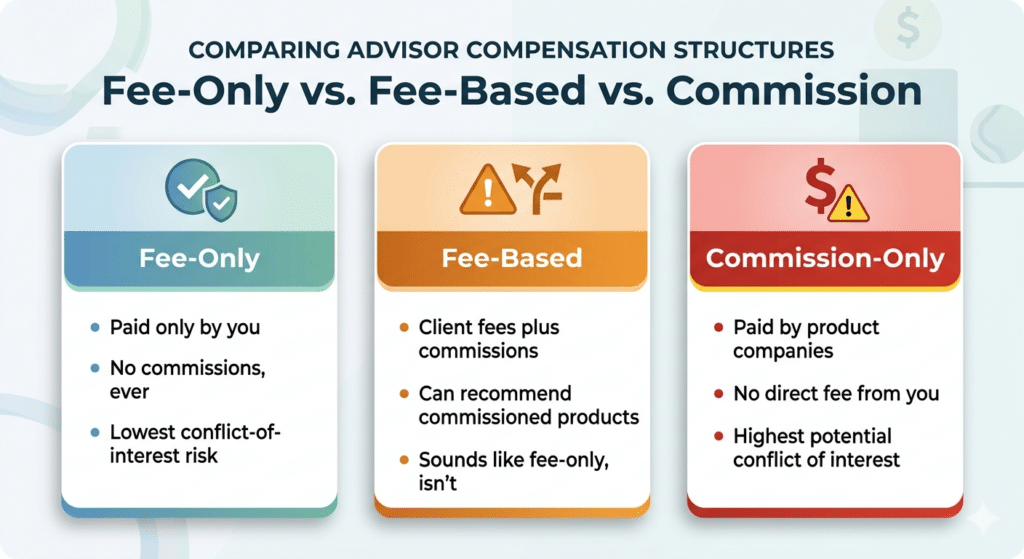
- How fee-only, fee-based, and commission-based models actually differ in practice
- What I do differently, and how you can independently verify it yourself
Why “Fee-Only” and “Fiduciary” Aren’t the Whole Answer
Let’s start with what these terms actually mean, because the confusion usually starts here. A fiduciary is legally required to act in your best interest. Fee-only means an advisor is compensated only by fees paid directly by clients — no commissions, no product sales, no kickbacks. Both are good things. Neither one, by itself, guarantees the advisor is right for you.
Here’s the gap most people miss. Fiduciary duty applies under the Investment Advisers Act of 1940. But it only applies when someone acts as an investment adviser representative. Plenty of advisors wear two hats. They’re a fiduciary when managing your portfolio. But they may become a commissioned insurance agent when selling you an annuity, or a broker held only to FINRA’s suitability standard rather than a fiduciary one. The SEC’s Regulation Best Interest and FINRA’s suitability rule both confirm that the standard an advisor is held to can shift with the “hat” being worn at that moment. Most consumers have no idea this hat-switch is even happening. That’s not necessarily dishonest on the advisor’s part. It may be fully disclosed and compliant. But the fiduciary label alone doesn’t guarantee consistency. It doesn’t tell you whether every recommendation meets the same standard.
The Questions I Think You Should Actually Ask
If you’re evaluating a financial advisor anywhere in the Kansas City metro — Overland Park, Wichita, Lawrence, or elsewhere — here’s what I’d ask, in order of how much I think each one actually matters:
- “Are you a fiduciary 100% of the time, with every recommendation you make to me, or only in certain situations?” This is the single most important question, and it’s rarely asked directly. If the answer involves any version of “it depends on the product,” that’s worth understanding fully before moving forward.
- “What is your CRD number, and can I look up your record myself?” Every registered investment adviser representative has a CRD number, which is searchable on the SEC’s Investment Adviser Public Disclosure website. If someone hesitates to share this or discourages you from checking, that’s a red flag, not a compliance nuance.
- “Walk me through every way you or your firm could possibly be compensated, including anything outside of the direct fee you charge me.” True fee-only means the answer is short: fees from clients, period. If there’s a pause here, or a list of “also sometimes” scenarios, that’s the moment to dig deeper.
- “What’s your typical client look like, and what’s your minimum account size?” Not because you need to feel like the biggest fish, but because an advisor whose typical client and process don’t match your situation may not build you a plan that reflects your specific needs, even with the best intentions.
- “Who is the actual custodian of my assets, and what happens if your firm ceases to exist tomorrow?” Your investments should sit with an independent, well-known custodian (Charles Schwab, Fidelity, etc.) — not with the advisor’s own firm. If your money isn’t at a real custodian, that alone should end the conversation.
5 Questions to Ask Before Hiring a Financial Advisor
Force transparent, written accountability from any prospective manager before trusting them with your retirement principal.
Are you a fiduciary 100% of the time, with every recommendation you make to me, or only in certain situations?
What to watch for: Beware of hybrid “fee-based” brokers who switch hats to sell commissioned insurance or mutual products under a lower suitability standard.
What is your CRD number, and can I look up your record myself?
What to watch for: A transparent advisor will instantly provide their FINRA/SEC CRD identifier. Verify their background free of charge via BrokerCheck.
Walk me through every way you or your firm could possibly be compensated, including anything outside of the direct fee you charge me.
What to watch for: If they cannot answer “strictly from your direct fee,” press for hidden 12b-1 trails, sales loads, or asset platform kickbacks.
What’s your typical client look like, and what’s your minimum account size?
What to watch for: Ensure their operational model aligns with pre-retirees managing complex distributions rather than broad, entry-level accumulation portfolios.
Who is the actual custodian of my assets, and what happens if your firm ceases to exist tomorrow?
What to watch for: Fiduciary firms use secure, independent third-party institutional custodians (like Charles Schwab or Fidelity) to safely hold your capital.
Fee-Only vs. Fee-Based vs. Commission: The Difference That Actually Matters
These three terms get used almost interchangeably by people outside the industry, but they describe very different compensation structures:
Advisor Financial Alignments: The Strategic Differences
Notice how close “fee-only” and “fee-based” sound. That’s not an accident — it’s one of the most common points of confusion in the entire industry, and I think some firms benefit from that confusion more than they’d like to admit.
What I Actually Do, and How You Can Verify It Yourself
I’m registered as an Investment Advisor Representative (IAR) under the Investment Advisors Act of 1940, which means I’m a fiduciary — full stop, not situationally. My CRD number is 2131294, and you can look up my registration directly at the SEC’s Investment Adviser Public Disclosure website (adviserinfo.sec.gov) rather than taking my word for it. My compensation is a fee schedule of 0.50% to 0.95% of assets under management annually, or a negotiated flat fee for outside advice — nothing else. Client assets are custodied at Charles Schwab, not held by me or my firm directly, and Schwab’s Customer Protection Rule prevents any firm from using client assets for its own business.
I bring all of this up not to sell you on working with me specifically, but because I think every advisor you’re considering — in Overland Park or anywhere else — should be able to answer these same questions just as directly, and should welcome you to verify every part of it independently. If they can’t, or won’t, that tells you something important before you ever sign an agreement. This distinction matters most on genuinely complex planning problems — see The Cross-State Retirement Map for a real example of why ongoing, best-interest optimization, not just suitability, is worth paying for.
LEARN MORE AT OUR FREE DIVIDEND GROWTH WORKSHOP COMING UP SOON – CLICK HERE!
Frequently Asked Questions
What questions should I ask before hiring a financial advisor?
Ask whether they are a fiduciary 100% of the time, for their CRD number so you can verify their record independently, exactly how they and their firm are compensated, what their typical client and minimum account size look like, and who actually custodies your assets. A true fee-only fiduciary should answer all five directly and in writing.
What’s the difference between fee-only and fee-based financial advisors?
Fee-only advisors are compensated exclusively by fees paid directly by their clients — no commissions or product sales. Fee-based advisors combine client fees with commissions on certain products, such as insurance or annuities, which can create conflicts of interest that a purely fee-only model avoids.
Is every financial advisor who calls themselves a fiduciary held to the same standard?
Not necessarily. Fiduciary duty under the Investment Advisers Act of 1940 applies when someone acts as an investment adviser representative, but the same person may act as a commissioned agent or broker in other contexts, where a different, lower standard, such as FINRA’s suitability standard or the SEC’s Regulation Best Interest, may apply instead. It’s worth asking directly whether an advisor is a fiduciary 100% of the time or only in certain situations.
How can I verify a financial advisor’s registration and background?
You can search any registered investment adviser representative’s record, including disciplinary history, at the SEC’s Investment Adviser Public Disclosure website (adviserinfo.sec.gov) using their CRD number, which any legitimate advisor should provide without hesitation.
Key Takeaways
- “Fee-only” and “fiduciary” are good starting filters, but neither term alone guarantees an advisor will act in your best interest with every recommendation, in every situation.
- The single most important question to ask is whether an advisor is a fiduciary 100% of the time, or only in certain situations, depending on the product being discussed.
- Fee-only, fee-based, and commission-based compensation models sound similar but work very differently — “fee-based” in particular is often confused with “fee-only” despite allowing commissions.
- A legitimate advisor should welcome you verifying their registration, CRD number, and compensation structure independently, rather than asking you to simply take their word for it.
Fee-Only Advice. Proven Process. Transparent Planning
Remember, there’s no one-size-fits-all approach to choosing a financial advisor. Conduct thorough research, consider your personal circumstances, and verify any advisor’s registration and compensation structure independently before making a decision.
P.S. Curious how your current advisor relationship stacks up against these questions, or starting your search from scratch? I’ve created a free Personalized Retirement Map that addresses all four critical areas: Income, Investments, Planning, and Legacy. No pitch, just clarity. → Get Your Free Personalized Retirement Map
Related Reading
Three Streams Financial, LLC is an independent financial firm. Investment advisory services are offered through CreativeOne Wealth, LLC, a registered investment adviser. CreativeOne Wealth and Three Streams Financial are unaffiliated entities. This graphic is for informational and educational purposes only and should not be construed as personal tax, legal, or investment advice. Consult a qualified CPA or fiduciary advisor regarding your specific multi-state tax footprint.

Hello, I’m Dan Gould, an independent fee-only advisor based in Overland Park, KS. I offer comprehensive financial services to individuals, families, professionals, and small business owners nationwide. With over 25 years of experience in institutional financial markets, I deliver proven portfolio management and retirement income strategies.