

Why I Think Most Kansas City Retirees Are Underinsuring for Long-Term Care
By Dan Gould | Three Streams Financial — Independent, Fee-Only Fiduciary Advisor
Here’s an uncomfortable number: a private nursing home room in the Kansas City metro now runs well over $7,000 a month. That’s more than $85,000 a year — for one person, for one type of care. Yet in my experience, the majority of KC-area retirement plans I review have no real answer for it. Not because clients aren’t smart or diligent. It’s because long-term care is the risk everyone acknowledges and almost nobody actually plans for, until they’re standing in a hospital hallway making a decision in a week they should have made five years earlier.
I’ll be direct: most writing about long-term care is either fear-mongering by insurance salespeople or false reassurance from Medicare (it mostly won’t cover it). My opinion: Most Kansas City retirees underinsure for long-term care. They price it using national averages, not KC-metro numbers. The gap between them is bigger than most people think.
This post will cover:
- What long-term care actually costs in the Kansas City metro, compared to national averages
- Why I think most local retirement plans underestimate this risk, and what Medicare actually covers (less than people think)
- Three real ways to pay for long-term care, and which ones I actually recommend for KC-area clients
- How this fits into the broader retirement income plan I build for clients on both sides of the state line
The Long-Term Care Numbers Kansas City Retirees Underestimate
Most long-term care planning advice you’ll read online is built on national average costs. The problem is that national averages don’t reflect what a facility in Overland Park, Leawood, or Lee’s Summit actually charges. Here’s how the Kansas City metro compares to national figures, based on industry cost-of-care survey data:
Long-Term Care Costs: Kansas City Metro vs. National Average
Figures are directional estimates based on published long-term care cost survey data and regional cost-of-living adjustments — get a current quote for your specific situation before making a decision. Sources: Genworth Cost of Care Survey (genworth.com/aging-and-you/finances/cost-of-care.html) and ACL.gov long-term care cost data (acl.gov/ltc/costs-of-care).
Notice that Kansas City actually runs a bit below the national average across the board — that’s the good news. The bad news is that “below national average” still means a private nursing home room can run $85,000+ a year, and the average length of stay for someone who needs that level of care is measured in years, not months. Run that math against a $1.5 million portfolio that’s also supposed to fund 25-30 years of regular retirement income, and you can see how fast an unplanned care need can derail everything else.
Why I Think Most KC-Area Retirement Plans Get This Wrong
I’ll say the unpopular part out loud: I think the retirement planning industry has done a bad job with long-term care, and it’s not really the clients’ fault. Here’s where I see it go wrong, over and over, in plans I review for new clients:
- “Medicare will cover it” is the single most common misconception I hear. Medicare covers short-term, medically necessary skilled nursing care after a hospital stay — typically capped at around 100 days — not the custodial, long-term care most people eventually need. Medicare.gov is explicit about this limitation (medicare.gov/coverage/long-term-care), but it’s still the single most common misconception I hear in client meetings.
- “We’ll just spend down and go on Medicaid” sounds like a plan, but it rarely is. It usually means a healthy spouse loses control over housing and asset decisions during an already difficult period, and Medicaid facility options are more limited than what most of my clients want for a parent or spouse.
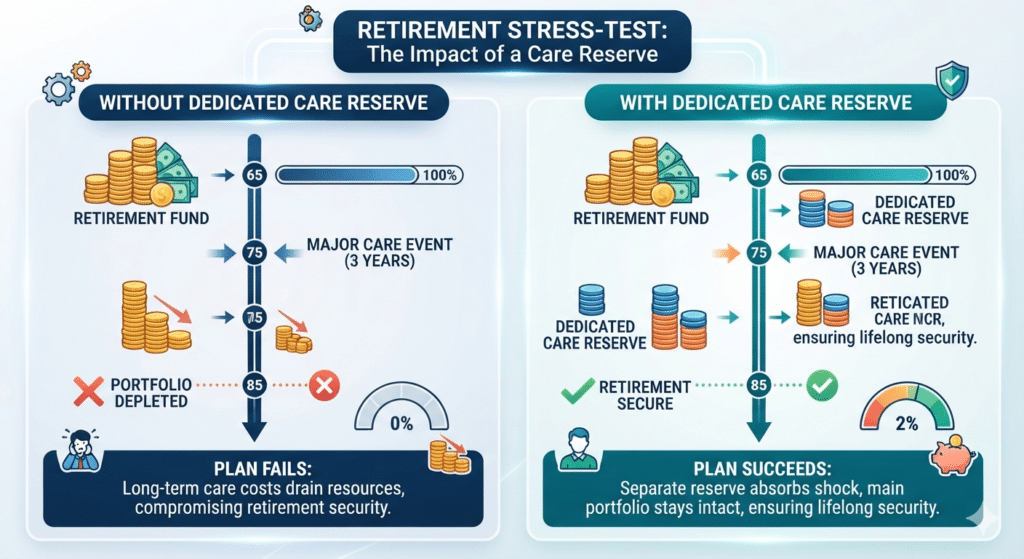
- Plans built purely on portfolio withdrawal math don’t stress-test a care event. A safe withdrawal rate calculation that works beautifully in a normal year can fall apart fast if you suddenly need to pull an extra $80,000 a year for care.
I’ve written before about how growing dividends can raise your safe withdrawal rate — but even a well-built income plan needs a separate answer for long-term care specifically. It’s a distinct risk with its own math, not something a generally sound portfolio automatically solves.
3 Ways to Pay for Long-Term Care
Once a client acknowledges the risk is real, there are really only three paths. Here’s how I think about each one, honestly:
Long-Term Care Approaches: The Honest Trade-Offs
Sources on LTC insurance mechanics and typical cost ranges: American Association for Long-Term Care Insurance (aaltci.org/long-term-care-insurance/learning-center/ltcfacts-2025.php).
None of these is universally “right” — and that’s exactly why I don’t think a generic national article can tell you which one fits. It depends on your specific portfolio size, health, and family history, which is a conversation, not a checklist.
What I Actually Recommend for Kansas City-Area Clients
For most of my clients across Overland Park, Leawood, and the broader KC metro, I don’t lead with a product. I lead with a number: what would a 3-year care event actually cost at today’s local rates, and does the current plan survive that shock without forcing a change in lifestyle for a healthy spouse? For many households, running that stress test is the first time anyone has put a real dollar figure on the risk, rather than a vague worry in the back of their mind.
Dividend Growth Investing as LTC Funding Strategy
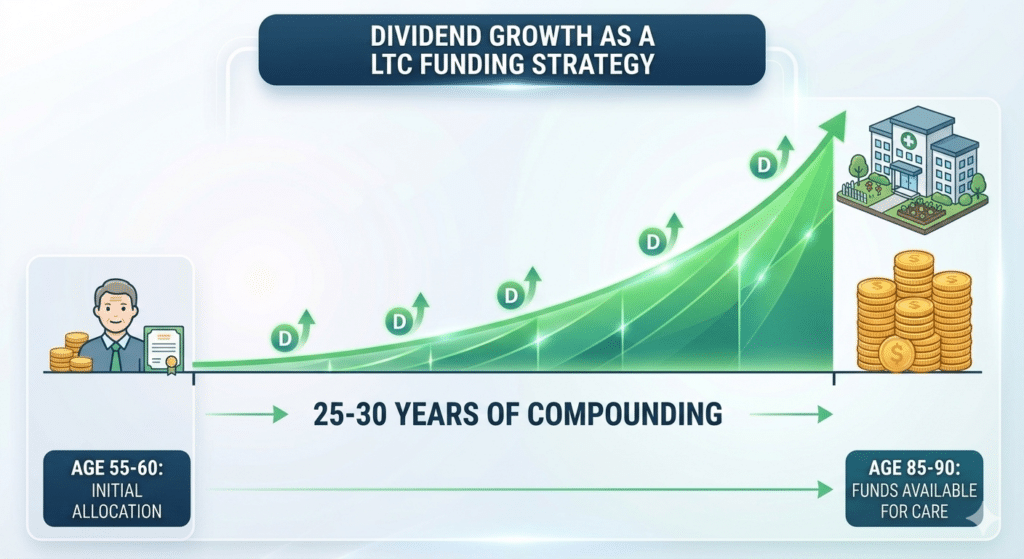
One approach I really like for clients in their mid-to-late 50s and early 60s is using dividend growth investing itself as the long-term care funding vehicle, not just a general portfolio strategy. Here’s the logic: if a client is 55-60 today, a long-term care need is statistically more likely to show up in their mid-80s or 90s — call it 25 to 30 years out. That’s an unusually long runway, and a long runway is exactly what dividend growth investing is built for.
Instead of setting aside a lump sum of cash that loses value to inflation over the decades, I allocate a dedicated portion of the portfolio. This section is funded while the client is still working or newly retired, and invested in high-quality dividend-growing stocks for 25-30 years. A modest investment now can grow in both share value and annual dividend income, becoming a fund ready for 2050s-era care costs. As dividends increase each year, this portfolio section naturally keeps pace with inflation. This approach helps address the challenge of preparing for costs that will arise decades from now, rather than using today’s dollars.
From there, it usually comes down to a mix — a partial self-insurance reserve or dedicated dividend growth sleeve built into the portfolio, sized to local KC costs rather than national averages, paired with insurance to cover the tail risk of a multi-year stay. I also want a plan that accounts for the healthy spouse — most plans I see focus entirely on the person who might need care and forget to protect the one who won’t.
LEARN MORE AT OUR FREE DIVIDEND GROWTH WORKSHOP COMING UP SOON – CLICK HERE!
Frequently Asked Questions
How much does long-term care cost in Kansas City?
In the Kansas City metro, a private nursing home room costs roughly $7,300 a month (about $87,000 a year), assisted living costs roughly $4,800 a month, and a full-time in-home health aide costs roughly $5,200 a month. These are directional estimates based on regional cost-of-care survey data — actual costs vary by facility and level of care needed.
Does Medicare pay for long-term care?
Only in a limited way. Medicare covers short-term, medically necessary skilled nursing care following a hospital stay, typically capped at around 100 days. It does not cover ongoing custodial long-term care, which is the type of care most people eventually need.
What are the main ways to pay for long-term care?
There are three main approaches: self-insuring by setting aside enough liquid portfolio assets to cover a care event, buying traditional long-term care insurance to transfer the risk for a set premium, or purchasing hybrid life insurance with a long-term care rider, which pays a death benefit if care is never needed.
Can dividend growth investing be used to pay for long-term care?
Yes. Because long-term care needs typically arise decades after someone first plans for them, a dedicated sleeve of dividend growth stocks allocated in one’s mid-to-late 50s can compound for 25-30 years before it’s needed, with the rising dividend income itself helping to offset future inflation in care costs.
Key Takeaways
- A private nursing home room in the Kansas City metro can cost $85,000+ a year — below the national average, but still large enough to derail an otherwise well-built retirement plan.
- Medicare covers only short-term skilled nursing care, not the ongoing custodial care most people eventually need — this is the single most common misconception I see.
- There are three real ways to fund long-term care: self-insuring, traditional LTC insurance, and hybrid life insurance with an LTC rider — the right one depends on your portfolio size, health, and family history.
- The right test isn’t “do I have insurance” — it’s whether your specific plan survives a multi-year care event without forcing a lifestyle change on a healthy spouse.
Fee-Only Advice. Proven Process. Transparent Planning
Remember, there’s no one-size-fits-all approach to investing or long-term care planning. Conduct thorough research, consider your personal circumstances, and consult a fee-only financial advisor before making any decisions. The cost figures cited above are directional estimates based on third-party industry survey data, not guarantees of actual future costs.
P.S. Wondering whether your own plan could survive a long-term care event without derailing everything else? I’ve created a free Personalized Retirement Map that addresses all four critical areas: Income, Investments, Planning, and Legacy. No pitch, just clarity. → Get Your Free Personalized Retirement Map
Related Reading

Hello, I’m Dan Gould, an independent fee-only advisor based in Overland Park, KS. I offer comprehensive financial services to individuals, families, professionals, and small business owners nationwide. With over 25 years of experience in institutional financial markets, I deliver proven portfolio management and retirement income strategies.