

How Growing Dividends Can Raise Your Safe Withdrawal Rate in Retirement
By Dan Gould | Three Streams Financial — Independent, Fee-Only Fiduciary Advisor
The number that used to anchor every retirement plan was 4%. Bill Bengen’s research said retirees could withdraw 4% in year one. They could adjust for inflation each year after. This gave a high chance of not running out of money over 30 years. Lately, that number has been drifting lower. Morningstar now puts the “safe” withdrawal rate closer to 3.9%. A few years ago, their estimate was 3.3%–3.7%. This was due to high equity valuations and a weak bond market
If you’re sitting on a nest egg and watching the “safe” number keep shrinking, that’s unsettling. One topic often gets left out. What happens when your portfolio’s income grows each year, even if stock prices do not? That is the idea behind dividend growth investing. I think it deserves a bigger role when clients and I plan withdrawals.
This post will cover:
- Why the traditional “safe withdrawal rate” math is really about avoiding forced selling at the worst possible time
- How a rising stream of dividend income changes that math — and where the popular “live off dividends only” idea overpromises
- What the historical record shows about dividend growth versus inflation
- Why dividend growers tend to smooth out the ride, and the honest limits of that protection
- How I actually build this into a client’s withdrawal plan
The Real Problem the “Safe Withdrawal Rate” Is Trying to Solve
Sequence-of-returns risk is key: The 4% rule, and more conservative updates, aren’t about a magic percentage. Sequence-of-returns risk is the danger that a bad market appears in your first few retirement years, forcing you to sell shares at depressed prices to cover living expenses. Sell too many shares too early in a downturn, and even a portfolio that would have been fine over 30 years on average can run dry. That risk is heaviest in roughly the first five years after you stop working, which is why researchers keep lowering the “safe” starting number as a buffer against bad luck.
Total-return investors address this risk by holding some bonds and cash and by adjusting spending when markets fall. In contrast, dividend growth investors have another lever: an income stream that doesn’t require selling anything to keep flowing—a stream that, history suggests, continues to grow even if stock prices are flat or falling.
How Rising Dividend Income Changes the Withdrawal Math
Here’s the mechanism in plain terms. Say you build a portfolio yielding 3.5% today, made up of companies with a track record of raising their payout every year. If the underlying businesses grow their dividends by, say, 6–7% annually — which is roughly in line with the long-run average for the S&P 500 and noticeably better for the Dividend Aristocrats — your income keeps climbing even in years the market goes nowhere. You’re not withdrawing a fixed percentage of a fluctuating account value; you’re spending a stream of cash that shows up whether or not you sold a single share that year.
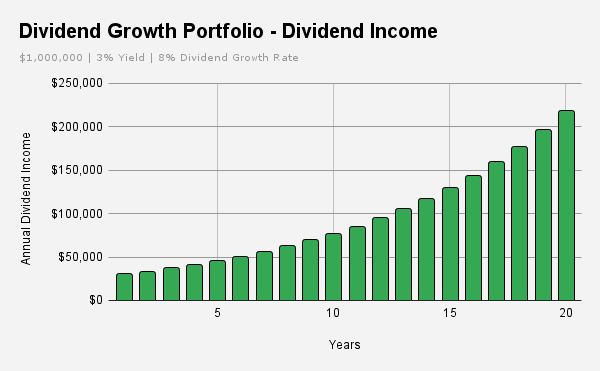
I want to be careful here. Some oversell this idea in personal finance as a “yield shield.” They claim it protects you from selling during downturns. But it doesn’t work that way. Dividends can be frozen or cut in a recession (valuations matter!). Even well-known payers cut dividends in the 2008–09 crisis. A “yield shield” built only on dividends struggled in 2020, too. A rising dividend stream reduces how much selling you need to do at bad prices. It doesn’t eliminate the need for a sensible mix of stocks, bonds, and cash, nor does it replace a real withdrawal plan.
The Inflation Case: What the Historical Record Shows
Inflation is the other half of the retirement math problem — the “safe” withdrawal rate has to hold up in real, after-inflation terms over two or three decades, not just nominal terms. This is where dividend growth has a genuinely strong track record. Going back to 1979, dividends on U.S. large-cap stocks have compounded at roughly 5.5%–6% annually, compared to inflation running closer to 3%. The Dividend Aristocrats — companies with at least 25 consecutive years of dividend increases — have grown their payouts at close to 6% a year over the past decade, again comfortably ahead of price increases over that stretch.
That gap compounds. A dividend that grows faster than your cost of living, year after year, means the real purchasing power of your income is increasing, not just holding steady. That’s a meaningfully different retirement experience than locking in a fixed-income stream — like a bond ladder or an immediate annuity — that pays the same nominal dollar amount for 20 years while your grocery bill quietly climbs.
Less Volatility, Not Zero Volatility
Companies capable of raising their dividend for decades tend to share certain traits: durable competitive advantages, disciplined balance sheets, and cash flow that doesn’t swing wildly from year to year. Those same traits — not the dividend itself — are typically what shows up as lower price volatility versus the broader market. It’s also psychologically easier to sit through a rough market when your account statement is down, but the check (or deposit) still shows up and is a little larger than last year’s.
The honest caveat: lower volatility isn’t no volatility, and a portfolio concentrated in dividend growers usually leans heavily toward sectors like consumer staples, industrials, healthcare, and utilities, with little exposure to fast-growing sectors like technology. That’s a feature during a downturn and a drag during a rally like we’ve seen recently. It’s a reason to treat dividend growth as one important ingredient in a retirement portfolio, not the entire recipe.
Which Should You Follow?
A question I hear often: should you plan retirement income around a safe withdrawal rate (like the 3.9% figure discussed above) or simply around your portfolio’s dividend yield? They’re answering two different questions, and mixing them up is where many retirement plans go wrong.
- A safe withdrawal rate is a spending rule applied to your total portfolio value — stocks, bonds, cash, everything — designed to answer the question: “How much can I take out this year without running out of money in 30 years?” It requires selling assets (or collecting interest/dividends) to fund the withdrawal, and it typically rises with inflation each year.
- Dividend yield is a property of your equity holdings alone — the cash income those specific stocks pay out, regardless of what the rest of your portfolio is doing or what your total spending needs are. A 3.5% dividend yield doesn’t know or care whether you need 3%, 4%, or 5% of your total net worth to live on.
In practice, the two work best together rather than as competing philosophies: use a dividend growth strategy to raise the quality and the growth rate of the income your portfolio produces, but size your actual annual withdrawal using safe-withdrawal-rate principles (a percentage of total portfolio value, adjusted for market conditions) rather than simply spending “whatever the dividends happen to add up to.” Retirees who rely solely on dividend yield for passive income can end up over-concentrated in high-yield, slower-growing sectors, chasing a bigger check today, often at the expense of total return and inflation protection that a properly diversified, total-return approach provides.
How I Build This Into a Client’s Withdrawal Plan
In practice, I don’t tell clients to abandon a total-return approach in favor of living solely off dividends, and I don’t recommend chasing the highest current yield. A more balanced approach:
- Use rising dividend income as your income floor, and treat occasional share sales — from either the dividend growers or the rest of the portfolio — as the flexible top-up, not the primary income source.
- Keep a real allocation to bonds and cash, sized to your spending needs for the first several retirement years, so you’re never forced to sell equities of any kind during a downturn.
- Screen for quality over yield — payout ratio, balance sheet strength, and competitive position matter more than the size of the current check.
- Diversify across sectors so you’re not overly dependent on staples and utilities alone.
- Revisit the plan annually, the same way you would any withdrawal strategy — a rising income stream is a tailwind, not a substitute for monitoring.
***Learn more at our dividend growth investing workshop coming up!***
Key Takeaways
- “Safe” withdrawal rate estimates have drifted down to roughly 3.9% in recent research, largely to guard against being forced to sell shares at depressed prices early in retirement.
- A portfolio of dividend growers can supply an income stream that keeps rising even when share prices don’t, reducing — but not eliminating — how much selling a retiree needs to do in a downturn.
- Dividend growth has historically compounded at roughly 5.5%–7% annually, comfortably ahead of average inflation, which supports rising real purchasing power over a long retirement.
- Dividend growers tend to be higher-quality, lower-volatility businesses, but the “yield shield” idea has real limits — dividends can be frozen or cut in a genuine downturn, so this works best alongside a sensible bond and cash allocation, not instead of one.
For more dividend growth information on our blog:
Fee-Only Advice. Proven Process. Transparent Planning
Remember, there’s no one-size-fits-all approach to investing. Conduct thorough research, consider your personal circumstances, and consult a fee-only financial advisor before making any investment decisions.
P.S. Want to see exactly where you stand? I’ve created a free Personalized Retirement Map that addresses all four critical areas: Income, Investments, Planning, and Legacy. No pitch, just clarity. → Get Your Free Personalized Retirement Map
Curious how this plays out in a real plan? See our case study on building a $150,000-a-year retirement income plan by age 62, which walks through this exact mechanism.
Raising your safe withdrawal rate is one piece of catching up on retirement savings. For the full 2025 game plan—drawdown control, dividend income, and catch-up contributions—read: Still Feel Behind in Retirement Savings? Why 2025 Is the Year to Take Action.
Related Reading
See this principle applied in our $150,000-a-Year Retirement Income Case Study, and read more on the underlying strategy in Dividend Growth Investing in 2026. Learn more about our retirement income planning process, or contact us to see how this could work for you.

Hello, I’m Dan Gould, an independent fee-only advisor based in Overland Park, KS. I offer comprehensive financial services to individuals, families, professionals, and small business owners nationwide. With over 25 years of experience in institutional financial markets, I deliver proven portfolio management and retirement income strategies.